
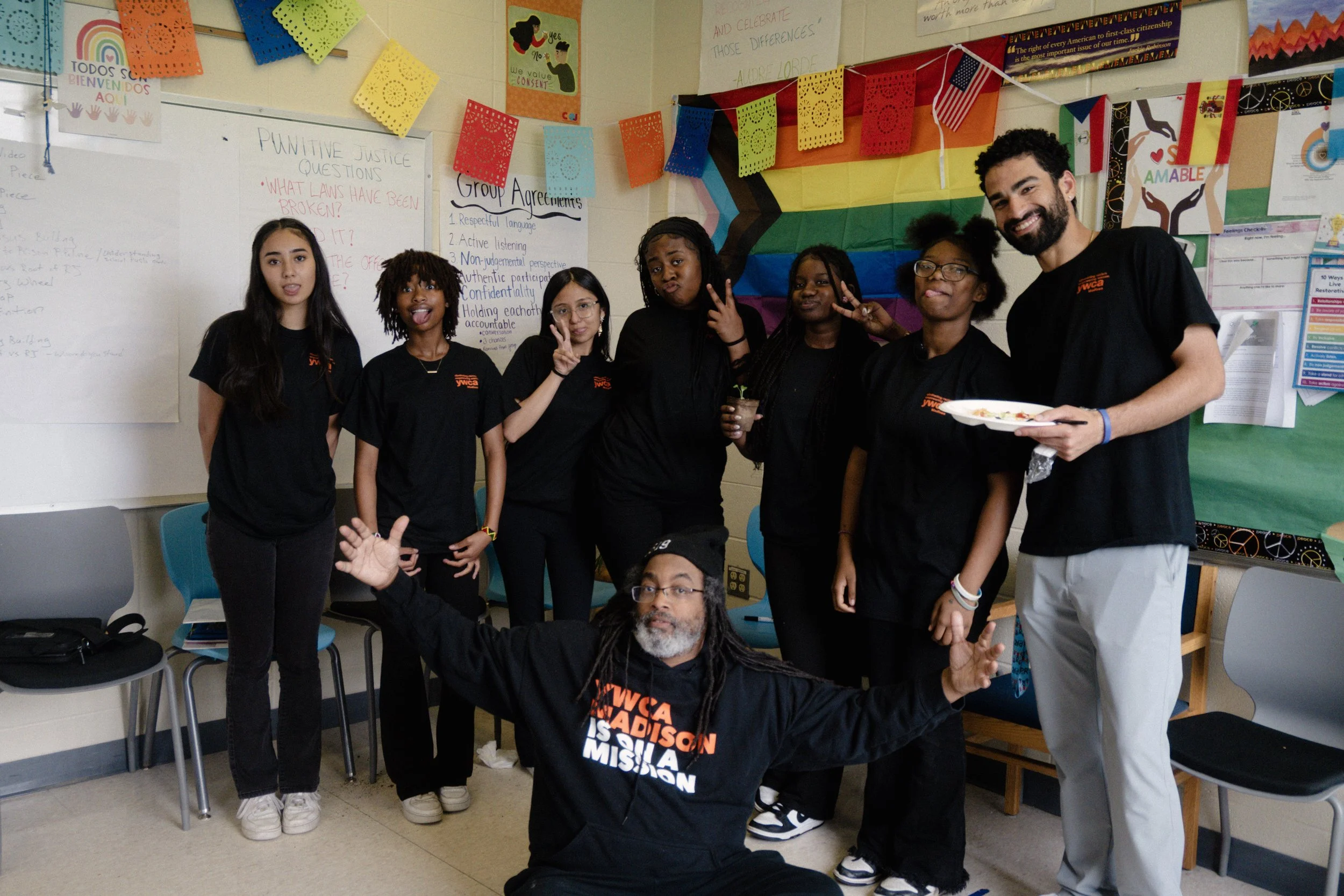
School based restorative justice
Transforming School Culture
We partner with local schools to develop and implement comprehensive Restorative Justice practices that challenge punitive systems and build community power. Students begin with a 9-lesson class that explores the school-to-prison pipeline, privilege and oppression, empathy, collective decision-making, and circle practice. After completing the class, students become Circle Keepers, youth leaders who facilitate circles that address harm, build accountability, and strengthen belonging. They continue growing their leadership and social justice skills through bi-weekly Restorative Justice Clubs.
We also support whole-school transformation by facilitating restorative circles for conflict resolution, harm repair, and community building. Educators receive ongoing coaching and professional development, including our 3-day Restorative Justice Training Series, to help schools move from punitive discipline toward healing-centered, restorative practices rooted in dignity and relationship.
Current partner schools:
Madison Metropolitan School District
Black Hawk Middle School
Sherman Middle School
James C. Wright Middle School
Monona Grove School District
MG21 Liberal Arts Charter School
Interested in bringing restorative justice programming to your school? Contact Eugenia Highland, Restorative Justice Director, for more information.
Eugenia Highland
Email: ehighland@ywcamadison.org
Interrupting the School-to-Prison Pipeline
The school-to-prison pipeline refers to the pattern where students are funneled from schools into juvenile detention or other carceral systems because of harsh, punitive discipline policies and interventions in schools. This has a life-long ripple effect, creating barriers for youth and disproportionately impacting BIPOC, LGBTQ+, and disabled students.
How are youth pushed into the School-to-prison Pipeline?
-
Many schools rely on rigid, zero-tolerance rules that lead to and sometimes require automatic suspensions or expulsions, even for minor misbehavior. These policies remove the opportunity for relationship-building, problem-solving, and support. Instead of addressing the root causes of behavior.
Zero-tolerance practices reinforce systemic harm by escalating situations that could be resolved through care, conversation, and restorative approaches to repair harm.
-
When students are pushed out of school, they lose access to academic instruction, community connection, and supportive people such as trusted adults and friends. Suspensions and expulsions disproportionately impact marginalized students, amplifying racial, gender, and ability-based inequities. There is a pleathora of research consistently demonstrating that removing students from learning environments increases disengagement, decreases graduation rates, and heightens the likelihood of deeper involvement with the criminal legal system. Exclusionary practices create long-term consequences for youth who need support and connection, not removal. These are harmful practices, reinforcing carceral notions that people are disposable.
-
In many districts, school resource officers (police) are used to respond to conflicts, behavioral needs, or emotional distress. When police are present in schools, adolescent behavior can quickly escalate to citations, arrests, or system involvement. This disproportionately impacts Black and Brown youth, reinforcing patterns of surveillance and punishment instead of providing students with trauma-responsive and developmentally-informed care.
-
Schools often respond to student behavior without considering the impact of trauma, developmental needs, or the environments young people are navigating. Actions that reflect stress, unmet emotional needs, or normal adolescent exploration are too often treated as disciplinary violations — or even criminal offenses. This criminalization disproportionately harms Black and Brown, LGBTQ+, and disabled youth, who already experience heightened surveillance and bias in school settings. Instead of offering support, guidance, and care, these responses deepen mistrust and push students toward system involvement.
At YWCA Madison, we believe every young person is inherently valuable and deserving of safety, connection, and opportunity. Our restorative justice approach is rooted in trauma-informed and developmentally-responsive practices that honor the full context of young people’s lives. We recognize behavior as communication and maintain that youth deserve community-based support, not systems that criminalize their humanity.
Resources to learn more about the School-to-Prison Pipeline
In the United States, the school-to-prison pipeline (SPP), also known as the school-to-prison link or the schoolhouse-to-jailhouse track, is the disproportionate tendency of minors and young adults from disadvantaged backgrounds to become incarcerated, because of increasingly harsh school and municipal policies.
The Advancement Project: What is the School-to-Prison Pipeline?
The American Civil Liberties Union: Dignity Denied: The Effect of Zero Tolerance Policies on Students’ Human Rights
The American Civil Liberties Union: The Schools for All Campaign: The School Bias and Pushout Problem
NAACP Legal Defense Fund: Dismantling the School-to-Prison Pipeline